Saturday, 10 January 2015

Research: Sub-genres

What are the Sub–Genres of Teen Drama films?

Sub-genres: films of the same genre, which use the same codes and conventions in a distinctively different way. It is also another way to categorize Teen Drama films in more detail.

There are two sub-genres for Teen Drama Film which are Youth Drama and High school.

Youth Drama: focuses mainly on the social problems faced by a group of people or the main character, which is often portrayed by a male character.

The character is shown as rebellious and in conflict with others such as adults or different groups of youngsters. Also, it focuses on the difficulties of adolescent experience and shows how being a youth is difficult.

This type of sub-genre is popular with teen audiences as it is seen to be more authentic.

Examples –Kidulthood, The perks of being a wallflower, My brother the devil.


High school: it is about the socialization of teens and young adults via institutions such as school, college or their homes.

They often celebrate the idea of being young but this is not always the case. This sub-genre is mostly girl centred but can also focus on a male lead. This sub-genre became popular in the 1970s.

Examples: Mean Girls, 10 things I hate about You, Ferris Bueller’s Day Off.


These two sub-genres focus on different aspects of communicating a teenager’s experience. So, the title sequence of each sub-genre is likely to be different as well. 

Thursday, 8 January 2015

Filming Screengrabs


Filming Screengrabs


Breakfast Club Remake

PLANNING FOR BREAKFAST CLUB REMAKE

CASTING:
Princess - Gabby
Athlete: Mimi
Basket case: Suad
Brains: Danica
Criminal: No name

PROPS:
Books for Brains
Camera
Coat for Basket case

LOCATION:
Cafeteria
College entrance
Classroom
College halls

FILMING:


Here's Danica filming a close-up of the clock,
homage to the original film.
Suad is holding the camera slightly higher than eye level,
to create a slight high-angle of Danica, The Brain
Danica is filming Mimi's outfit which is a typical 'athlete' outfit.
Consisting of trainers and an athletic jacket.
In order to get a low angle shot, Danica is crouching down
and tilting the camera upwards
Mimi filmed a tilt of the lockers with graffiti saying 'I hate Mondays!!'
Mimi is importing all of our clips from our
hard drive on to Final Cut Pro

In order to make the our re-make look similar to the original, we had to put temporary graffiti on the lockers. We used white board pens, so that we could rub it out afterwards.We had to get an extra to be 'The Criminal' and Suad, from group 27 joined our group. The allowed us to have 5 distinctive characters, without any of us being two characters. We found locations that resemble the locations shown in The Breakfast Club, such as the cafeteria, the classroom, the locker hall and the detention room. When filming, we had to consider the surroundings, as we filmed during the school day.

The Breakfast Club Opening - Planning

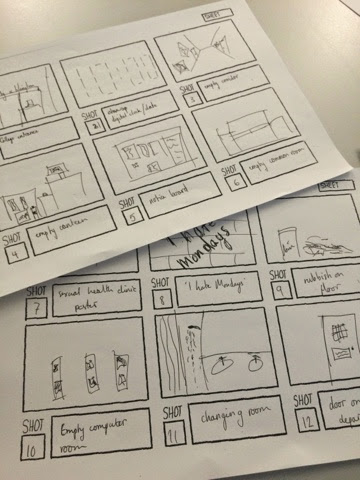
Explanation of task: Using the opening titles credits and scene from The Breakfast Club, we made notes on the order the credits appeared in, and what shots were used, in order for us to be able to recreate it. Some shots had to be substituted, so we made a storyboard and shot list in order to help us plan filming. 
 
Director - Sheldon 
 
Cameraman - Sheldon, Rachael

Characters-
Basket Case - Jack
Athlete/Jock - Karim
Princess - Sana
Brain - Miraj
Criminal- Sheldon

Two other people were cast as two of the characters as the group did not have enough people.


Props-
Varsity Jacket (Optional)
Phones
Pens
Bright Red Coat

Locations-
College entrance
Angel Train Station
Bus stop
Street outside college/college gates
Owens Field
Hallways
Canteen
Common room
Main hall

Canteen
Hall
Empty Corridor
Lift
Library
Empty Hallway
Common Room
Classroom

The locations were changed as, some locations were not filming friendly due to the unforeseen weather therefore, some locations were kept out of the places where the filming would be conducted.


Substituted conversations in cars in the film for phone calls and text messages, in order to adapt it in our way

The teacher was excluded because in the film he shows at the end in the opening and isn't very significant.

 
He's a picture of some of out planning sheets which was drawn in so that it would give us a rough idea of what our group would do when filming. Description in each of the boxes under the pictures are short in order to keep it simple rather than making it long worded which may be hard to understand later on.


Here is a picture of what was written down on one of the shot lists including every single detail that was needed to be known.


Rachael is shown adjusting the camera, in terms of the height at which the footage would be shot and what the camera would be able to film through the viewer.


This picture shows three of the characters, in our adaptation of The Breakfast Club. Princess, who is holding her phone with a frustrated look on her face as well as the fact she dressed very fashionable way and the phone just emphasizes that image. You have the athlete sitting next to her, leaning on his arm, wearing a sports jacket which presents him as the athlete. At the very back, you hardly see the character and he's dressed in black which gives the image that he is the Basket Case, being far away from every other character and being isolated.


In this picture you have Rachael filming, the criminal who can be identified by the puffy coat he is wearing as well as the fact that he has his hands in his pocket which shows he may have something to hide as he's very closed up.

For this shot, Rachael is getting a close up of the criminal.


Jack is playing the Basket Case. The posture of the Basket Case, is very lazy giving off the image that he doesn't care as his feet are stretched out and his hands are just lying on him and he is leaning on a table. This therefore portrays him to be the Basket Case as in the film, the character act in a very similar manner. Black clothing also gives the image of a bad guy, as black in some texts are associated with evil, mean, dark etc.


Rachael is adjusting, the angle at which the footage is being shot to get a close up shot of one of the characters from a slightly high angle.


Tuesday, 6 January 2015

Individual XMAS homework task 20: Watch, research into and answer questions on a Teen film of your choice (The Breakfast Club)

Individual XMAS homework task: Watch, research into and answer questions on a Teen film of your choice (The Breakfast Club)

Plot: They were five students with nothing in common, faced with spending a Saturday detention together in their high school library. At 7 a.m., they had nothing to say, but by 4 p.m.; they had bared their souls to each other and become good friends. To the outside world they were simply a Brain, an Athlete, a Basket Case, a Princess, and a Criminal, but to each other, they would always be the Breakfast Club.

Cast:

·      Emilio Estevez. = Andrew Clark.
·      Paul Gleason. = Richard Vernon.
·      Anthony Michael Hall. = Brian Johnson.
·      John Kapelos. = Carl.
·      Judd Nelson. = John Bender.
·      Molly Ringwald. = Claire Standish.
·      Ally Sheedy. = Allison Reynolds.

Country: USA.

Budget: $1 Million.

Box office: $51,525,171.

Box office Gross: $38,100,000.

Genre: Teen movie, Drama, Comedy.

Themes: The main theme of the film is the constant struggle of the American teenager to be understood, by adults and by themselves. It explores the pressure put on teenagers to fit into their own realms of high school social constructs, as well as the lofty expectations of their parents, teachers, and other authority figures. On the surface, the students have little in common with each other. However, as the day rolls on, they eventually bond over a common disdain for the aforementioned issues of peer pressure and parental expectations. The main adult character, Mr. Vernon, is not portrayed in a positive light. He consistently talks down to the students and flaunts his authority throughout the film. Bender is the only one who stands up to Vernon.

Stereotyping is another theme. Once the obvious stereotypes are broken down, the characters "empathize with each other's struggles, dismiss some of the inaccuracies of their first impressions, and discover that they are more similar than different.

Target Audience: The target audience of The Breakfast Club is based around the teenage market (ages 13-18). This illustrates the social classes of high school and parent pressures to succeed. Teenagers could identify with the characters because they are in different stereotype groups.

Stereotypes: Adolescence is the time of transition between childhood and adulthood-biological development leads to psychological, social and economic changes, toward ever-increasing independence. Adolescence involves the development of a sense of identity; it is a time of questioning of relationships to parents and to peers, and of roles in society.
Relationships with others dwell at the core of the adolescent experience. As teenagers move away from their parents, peer groups play an integral role. Adolescents "place a lot of importance on belonging, on being included, and on being part of a group; group affiliation not only supplies emotional security, but also is a source of status and reputation with motivational properties" (Cotterell 1). The cliques and crowds formed by adolescents define them within in their own social world and to (or against) the adult world as well. The boundaries between these groups can be ambiguous and flexible or extremely rigid and unforgiving. The five students assembled for Saturday detention in The Breakfast Club represent five different groups, stereotyped both by their fellow students and the school administrator who is their warden for the day.

    Claire Standish (Molly Ringwald) is the princess, the Prom Queen, Miss Popularity.
    Brian Johnson (Anthony Michael Hall) is the brain, the geek, and the "neo-maxie zoom deebie."
    Andrew Clark (Emilio Estevez) is the athlete, the jock, "Sporto."
    John Bender (Judd Nelson) is the criminal, the rebel, the punk.
    Allison Reynolds (Ally Sheedy) is the basket case, the loner, and the weirdo.


The strict confines of high school status groups separate the characters. Claire and Andrew might know each other, they might even end up at the same big parents-are-out-of-town party, but they do not "hang out." None of the others would even speak to one another under normal circumstances. But Saturday detention is like a parallel universe-it creates a separate sphere where these divisions can eventually be set aside. In the "other world" their punishment creates, the members of the Breakfast Club are allowed to move beyond these social norms and distinctions. They interact with each other, learning the details of the lives beneath the stereotypes, and find common ground.  


Individual Post 15: Pick a title sequence from either High School or Youth Drama and analyse camera, editing, sound and M.E.S

Individual Post 15: Pick a title sequence from either High School or Youth Drama and analyse camera, editing, sound and M.E.S


Title sequence: The Breakfast Club.

Sub-Genre: High School.

Genre: Drama, Comedy.


Camera: The camera angles and shots in this scene give a lot of insight into each character’s feelings even when they are not talking or being spoken to.  When the camera is focused on each character it is an eye level shot, implying that every character is actually on the same level even though they have put labels on themselves for their social standings. Allison acts as a bystander in this scene and is not very active in the discussion; the camera is only on her when she is talking.  The camera lingers on Andrew when he says his lines so as to show that he is thinking about what he is saying and that he is feeling conflicted about his past views.  When other characters are giving lines, the camera sometimes briefly pauses on Andrew so that the audience can see his reactions and thoughts.  For the majority of Claire’s lines, the camera does not focus on her, but instead on the reactions of the other characters.  However, when she brings up a new point the camera returns to her as a close up shot to show her full emotions and that she is being very honest.  When John is yelling at Claire, the camera moves to a wider shot of her so her full body language is shown to the audience who can recognise her anger, vexation and annoyance.  John does not speak at the start of this scene but his face is shown so that the audience can see him considering the ideas of the others and his reactions.

Editing: The shot reverse shot is the only major technique in the opening scene, when the teacher is addressing the students and telling them off. There is very little use of transitions, slow/fast motion or any significant shots.

Sound: The opening scene of the movie is filled with mostly soundtracks from the
80’s, including songs like "Don’t you (Forget about me) – Simple minds “Waiting" – E.G daily. The opening scenes contain a mixture of non-diegetic and diegetic sounds.  Diegetic sounds include car doors slamming shut and sounds of them eating their lunch. The dialogue in the opening scene is limited as it is mostly the use of music and soundtracks.

Mise-En-Scene: The props include food and cigarettes and vehicles such as cars. The first thing we see is a classroom with computers in it and the narrator tells us that

this is supposed to represent ‘a brain’. The next part of the school that we see is an empty locker room with some sort of sports kit and this is to represent ‘an athlete’ as told to us by the narrator. The next part of the school that we see is an office, a ‘guidance counselors’ office to be exact which seems to have some sort of psychological tests on that are used in therapy for people who need mental help and this is supposed to represent ‘a basket case’. We are then shown a banner, which says ‘vote for prom queen’ and the narrator, tells us that this represents a ‘princess’ and the last prop that we see is a locker, which someone has, wrote ‘open this locker and you die fag’ and this is to represent a ‘criminal’. All of these props foreshadow the personalities of the characters that we are eventually going to meet. The costumes do contrast. Bender is dressed in scruffy and untidy clothes; meanwhile characters like Clair and Bryan are wearing smartly dressed attire. Lighting seems to be very dark in the school, suggesting that the mood in the school is very miserable and gloomy.